
Psychosocial Safety
An integrated SAP & SafetySuite approach to regulatory compliance, workforce protection and mental health.
Psychosocial Safety is no longer a policy.
It's a legal duty, and a governance risk.
BEYOND COMPLIANCE
Australian WHS law now requires you to identify, assess and control psychosocial hazards with the same rigour you apply to physical safety. Training and EAP referrals won't cut it. You need a system that proves you acted and before harm occurs, not after. Built for the executives, boards and WHS/HR leaders who now carry this risk together.
Built for the executives, boards and WHS/HR leaders who now carry this risk together.
Trusted across 25+ years protecting workers throughout Australia and New Zealand.
Your safety system was built for physical risks. From a duty of care, to a culture of care.
THE CHALLENGE
There's no shortage of awareness here. Boards are asking about psychosocial risk, regulators are scrutinising it, and most WHS and HR leaders have already invested in policies, training and EAPs. The harder question is operational: how do you identify, manage and reduce this risk before it becomes a case, rather than after?
That gap exists because the ground underneath it has already shifted. Psychological health used to sit under the general duty of care - important, but informal. Regulators across every Australian jurisdiction now expect more. Employers must:
Identify psychosocial hazards arising from how work is designed, led and resourced
Assess them for severity, duration and frequency
Eliminate or control them using the same hierarchy of controls applied to physical risk
Consult with workers and HSRs, and document that consultation
Monitor and review whether controls are actually working
Here's the part that should worry your board: information and training alone are no longer defensible. If your only controls are an EAP number and an annual e-learning module, a regulator - or a plaintiff's lawyer - can argue the hazard was foreseeable and left unmanaged. That's not hypothetical. A Victorian teacher was awarded over $1 million after his employer failed to act on repeated concerns about an unmanageable workload. The court found the school had neglected its duty. The same exposure exists in any organisation that manages psychosocial risk through anecdote instead of evidence.
70%
of exiting workers cite low co-worker support and low job control
1 in 3
workers report ongoing exposure to three or more of the "Big 6" psychosocial hazards
161% increase
to mental health claims over the past decade and growing 15% year on year
Most organisations manage psychosocial harm the same way: HR picks up a case once someone is already distressed, in conflict, or on leave. By then, the damage is done - productivity has dropped, trust is strained, and the file is now in the hands of HR, legal, insurers and sometimes the media.
This reactive model treats symptoms, not systems. The hazard that caused the case is still there. So the same risk resurfaces, again and again, each time a little more expensive.
What that actually costs:
Mental stress claims carry a median payout of $69,900, more than triple the average across all other injury types, and the longest median time lost of any claim category (36.8 weeks)
Psychosocial claims now represent 11.5% of all serious claims, and that share is rising faster than every physical injury category combined
Untreated mental health conditions cost Australian business an estimated $10.9 billion a year in absenteeism, presenteeism and compensation
For a typical 1,000-employee organisation, direct injury costs alone (WorkCover premiums, replacement labour, other direct costs) run to roughly $4.18 million a year, and at a 4.6% net margin, that's over $90 million in additional revenue just to stand still.
And it's not only a financial exposure. Officers and directors now carry personal liability for failing to manage psychosocial risk, with WHS breaches treated as criminal offences carrying fines up to $3 million per jurisdiction.
Reactive management doesn't just cost more. It compounds.
THE COST OF GETTING THIS WRONG
Wellbeing-Centred Safety:
one system, not two conversations
THE SOLUTION
The mistake most organisations make is treating psychosocial risk as an HR problem, isolated from their safety system instead of built into it.
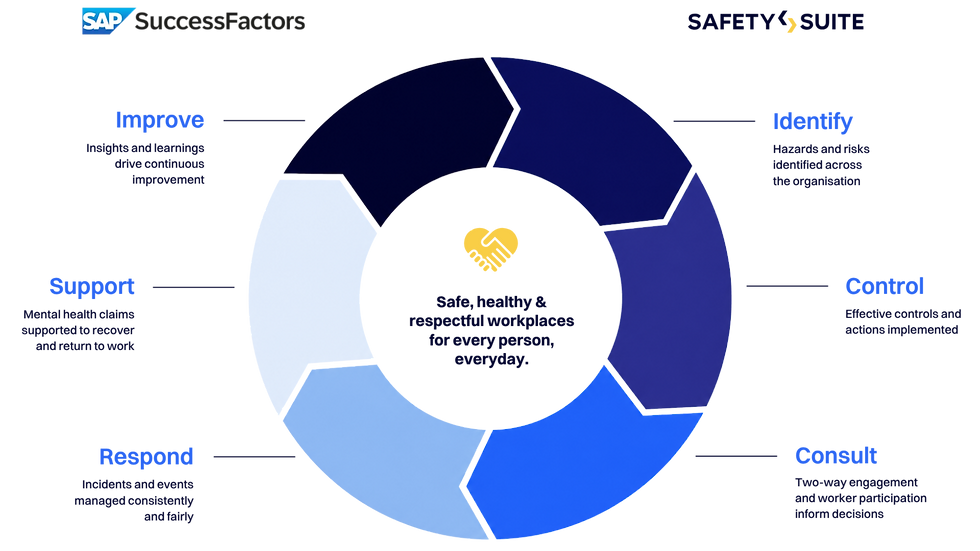
SafetySuite closes that gap. Integrated with SAP SuccessFactors, our platform brings psychosocial hazard management into the same architecture available for physical safety, injury management and HR case handling - one risk register, one governance framework, one source of truth your board can actually see.
That means psychosocial hazards are:
Identified
By workers and managers through the same reporting pathways as any other hazard.
Assessed
Using structured, defensible risk methodology, not a spreadsheet or a gut call

Controlled
In line with the hierarchy of controls regulators expect, prioritising changes to work design over training alone
Tracked and Reviewed
With full audit trail, so when a regulator or a court asks "what did you do, and when?" - you have the answer

Regulators have said explicitly that it isn't. Information, instruction and training are necessary but not sufficient - you also need structural controls that change how work is designed, resourced and led. An EAP is a support mechanism, not a hazard control.
We already have an EAP and mental health training - isn't that enough?
Who actually owns this: HR or Safety?
Ask ten organisations who owns psychosocial risk and you'll get ten different answers. HR has traditionally led employee relations, workplace behaviour and bullying investigations. Health & Safety carries the regulatory duty to identify, assess and control hazards - psychosocial included - using the same systematic rigour applied to physical risk. Neither is wrong. But psychosocial risk doesn't respect an org chart: it lives in how work is designed, led and resourced, and it needs HR, Safety and operational leaders working from one shared register - not a fragmented view split across two teams and two systems. That's what SafetySuite gives you.
From hazard to evidence, in one platform
HOW IT WORKS
Confidential Reporting, Wherever People Are
01
Workers and managers raise concerns through safe, structured channels - removing the barriers that keep psychosocial hazards hidden until they become HR cases.
Structured Risk Assessment
02
Every hazard is assessed for severity, duration and frequency, and matched to a hierarchy-of-controls response - not a training module by default.
Action, Accountability and Consultation
03
Controls are assigned with clear ownership, consultation with workers and HSRs is logged automatically, and nothing sits unactioned
in an inbox.
Monitoring, Review and Audit-ready Evidence
04
Lead and lag indicators feed straight into governance reporting, so your executive team and board see psychosocial risk the same way they see any other material risk - with real data, not a survey once a year.
Because it runs on SAP SuccessFactors, none of this sits in a separate system your teams have to remember to check. It's part of how the organisation already works.

Give your leadership what they now need to provide: evidence, not anecdotes
WHY THIS MATTERS AT BOARD LEVEL
See psychosocial risk represented in the organisational risk register, alongside financial and operational risk
Understand how it's assessed and prioritised
Confirm controls are implemented and working - with evidence, not assurance from a meeting
Intervene early when a risk is escalating, rather than find out after a claim is lodged
Regulators increasingly require officers and executives to:
SafetySuite gives you that visibility without building a parallel reporting process. The same platform that manages incident and injury data now gives you psychosocial risk in the same dashboard, the same language, the same governance rhythm.
PROVEN AT SCALE
Trusted where the stakes are highest
SafetySuite has spent over 25 years managing risk and building safety systems for organisations where getting it wrong isn't an option - across state government departments, national self-insurers and complex, multi-agency environments - protecting workers across Australia and New Zealand.
60%
Reduction in serious injuries reported by organisations after implementing SafetySuite
78%
Improvement in incident investigation compliance for a state government department using SafetySuite to monitor and escalate against policy
95%
Of manual safety data entry automated, freeing safety teams from spreadsheets and into prevention
100%
On-time completion of safety actions, replacing systems where over 1,000 actions
had gone dormant


Frequently Asked Questions
No. SafetySuite is a native extension of SuccessFactors, not a bolt-on. Your existing employee data, org structure and workflows carry straight through, so psychosocial risk management sits inside the system your teams already use, rather than becoming another login to manage.
We're already running SAP SuccessFactors - does this mean a whole new system?
It depends on your safety maturity and existing configuration, but SafetySuite's preconfigured, industry-specific templates are built for speed. Your implementation partner will assess where you're starting from and build a blueprint scaled to your organisation - the fastest way to find out your timeline is to walk us through your current setup.
How long does implementation actually take?
Role-based access, data segregation and legal privilege controls are built in. Organisations managing highly sensitive matters - including state government departments with cross-agency confidentiality requirements - run on the same platform.
What about privacy and confidentiality for sensitive cases?

See what a defensible psychosocial safety system actually looks like
You don't need another policy document. You need a system that shows the regulator, your board and your people that the risk was identified, controlled and reviewed - before anyone was harmed.
Why organisations choose SafetySuite:
One risk register for physical and psychosocial hazards
Natively integrated with SAP SuccessFactors
Audit-ready evidence your board and regulators can actually see
Give us 30 minutes, and we'll show you how psychosocial risk fits inside the safety system you already run.